
Growth Teardown: Chili Piper's Pricing Trap
Chili Piper raised $55M, hit $43M ARR, and hasn't raised again in 4 years. Here's the exact SaaS pricing strategy mistake that's keeping them stuck.
Hussein Saab
May 13, 2026
GTM, Pricing
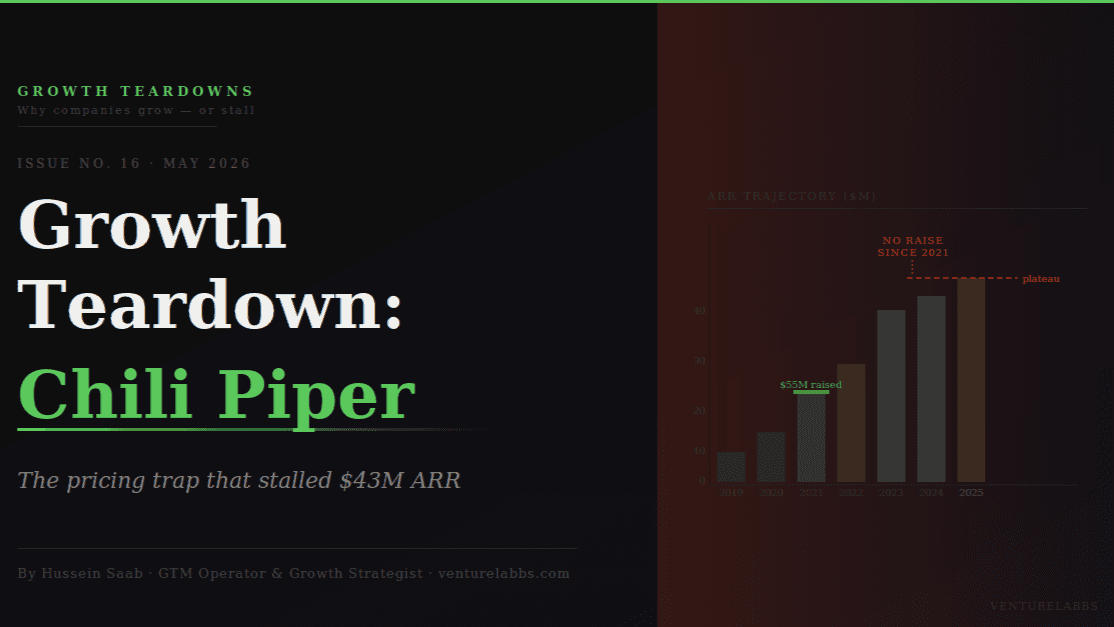
Chili Piper has $43M in annual revenue, a $1B valuation from 2021, and clients like Spotify, Airbnb, and Intuit plastered across their homepage.
They also haven't raised a dollar since April 2021.
That’s a long gap for a company at that scale, but it can also reflect profitability or a shift in strategy rather than stagnation. Four years where every competitor they created demand for HubSpot, Calendly, Apollo has kept closing the gap while Chili Piper has been busy doing brand refreshes and relaunching products that nobody noticed the first time.
I’m not making a definitive claim about their trajectory here. I’m looking at a pattern that shows up often in growth-stage SaaS companies. But there's a very specific GTM architecture problem happening here that I see in growth-stage SaaS companies constantly and it's worth pulling apart before you make the same mistake in your own pricing model.
What They Built Was Real
Let me give credit where it's due. Chili Piper identified a real problem: inbound leads dying in the gap between form submission and first contact. Speed-to-lead is one of the most documented revenue leaks in B2B sales studies consistently show that responding within five minutes versus thirty minutes produces dramatically different conversion rates. They built real infrastructure around routing, scheduling, and handoff that genuinely solves this for enterprise revenue teams.
They grew from $7M ARR in 2020 to $35M in 2023 on the back of that wedge. That's not luck. The product earned its traction.
So what broke?
The Three Cracks in the Foundation
The Pricing Maze
Chili Piper sells four separate products: Concierge, Chat, Distro, and Handoff each priced individually, each requiring its own platform fee buried in fine print so small that reviewers on Capterra literally noted it's written in 6-8pt typeface on their pricing page.
This is a classic trap I see growth-stage SaaS companies fall into when they expand from one core product to a platform. They build new features, monetize each one separately, and call the result "flexibility." What buyers experience is confusion, sticker shock, and a procurement process that takes three times longer than it should.
The G2 reviews tell the story plainly. Reviewers love the routing functionality. Then they hit the pricing structure and the tone shifts: "expensive and complicated," "surprise fees," "high price point compared to other schedulers." These aren't complaints about value they're complaints about predictability. Buyers can't budget for what they can't understand.
When your pricing requires a CSM to explain it, you don't have a pricing model. You have a negotiation posture. And that posture works at enterprise scale with long sales cycles and procurement teams. It destroys conversion at the mid-market level where most of your ICP lives.
The Repositioning Fog
In 2021, Chili Piper was a scheduling and routing tool. By 2024, they were a "Demand Conversion Platform." Somewhere in between, they acquired KosmoTime (a smart calendar startup), launched a Chat product, and did a full brand refresh with a new design agency.
Here's the damning part: Chili Piper's own marketing team admitted publicly in their 2024 year-in-review that when they launched Chat, customers thought it was just a repositioning announcement, not an actual new product. Their exact words: "people thought it was just a repositioning. They didn't actually realize we launched a new product."
Read that again. You built a new product. Announced it to your market. And your market couldn't tell it was something new because your positioning was already so blurry that a product launch looked like a messaging update.
...Bro!! 🤦🏾
That's not a marketing problem. That's a GTM architecture problem. When messaging shifts faster than customer understanding, new launches often fail to land, not because the product is weak, but because the category framing is unclear. You have to go back to the foundation and answer a simpler question: what is the one problem we solve better than anyone, and who has that problem most urgently right now?
The Commoditization Squeeze
Chili Piper is caught between two gravitational forces pulling in opposite directions, and they haven't picked a lane.
At the bottom, Calendly is eating them alive on simplicity and price. Calendly (which I will hit with a Teardown next) has 4.7 stars on G2 versus Chili Piper's 4.6 essentially identical satisfaction score, but at a fraction of the cost and with a setup time measured in minutes instead of weeks. For any company that doesn't need the complex routing logic, the choice is obvious.
At the top, HubSpot and Salesforce are embedding scheduling and routing natively into their platforms. Every quarter that passes, those native integrations get more capable. Chili Piper's value proposition narrows.
The smart play would have been to go hard upmarket price for the enterprise, build the sales motion for the enterprise, and stop pretending the mid-market self-serve buyer is part of the ICP. Instead, they have a pricing structure that is too complex for small teams and too cheap for enterprise procurement to take seriously, with a brand that tries to speak to everyone and ends up owning no one.
The Pattern: The Middle-Market Squeeze
What's happening to Chili Piper has a name. I call it the Middle-Market Squeeze and I see it in growth-stage SaaS companies more than almost any other failure pattern.
It works like this: You build a product that solves a real problem. You find traction in the mid-market. You raise money and try to expand in both directions simultaneously simpler and cheaper for SMBs, more capable and expensive for enterprise. In doing both at once, you build a pricing model that confuses SMBs and underwhelms enterprise. Your growth slows. You reposition. Buyers get confused. You do a brand refresh. Nothing changes.
The companies that escape this pattern make a hard choice. They pick the customer they want to own and design everything: pricing, packaging, sales motion, support model, around that customer exclusively. The companies that don't make that choice end up exactly where Chili Piper is: growing slowly, not raising, repositioning annually, watching competitors eat from both sides.
Three Questions to Run on Your Own Business Right Now
Is your pricing something a buyer can explain to their CFO in one sentence? If your pricing requires a discovery call, a demo, and a CSM conversation before the number makes sense, you've shifted pricing risk onto the buyer. They will stall, delay, or choose the option they can budget for predictably. Complexity in pricing is always a conversion killer regardless of how much value the product delivers.
How many times has your core positioning changed in the last 24 months? Once is refinement. Twice is a signal. Three times means you haven't found the customer whose problem you solve so well they'd fight to keep paying for it. Repositioning without first finding that customer just burns your brand equity and trains your market to wait for the next version of you.
Are you trying to compete at two price points simultaneously? If you have a free tier or a low-entry SKU designed for SMBs AND an enterprise motion targeting Fortune 500 procurement teams, you're fighting two different wars with the same army. Pick the war that's winnable with your current resources. You can always expand later. You cannot afford to lose both at once.
If you ran those three questions on your own business and didn't like what came up, start with the diagnostic at growthleakfinder.com, it takes five minutes and shows you exactly where the revenue leak is.
If you want to go through it live, grab 30 minutes here.
And if you want me to run this teardown on your company, send me your URL. I do these free.
Related reading: Growth Teardown: HubSpot's All-in-One Trap | Stop Chasing Zombies: Kill Metrics