
Growth Teardown: Why Plooto is Leaking Activation Before the First 'Aha'
Growth Teardown: Why Plooto is Leaking Activation Before the First 'Aha'
Hussein Saab
Feb 27, 2026
GTM, B2B SaaS
Growth Teardown: Why Plooto is Leaking Activation Before the First 'Aha'
Welcome to Growth Teardowns. Every week, we strip away the slide-deck strategy and internal debate to look at real-world examples of why companies scale or stall. We analyze how high-growth companies actually function—or fail—so leadership can make confident go/pivot/kill decisions based on real market signals.
_________________________________________________________________________
You just authorized a $50,000 monthly spend on customer acquisition. Your marketing team is high-fiving because the Cost Per Click (CPC) is down and sign-ups are up. But three months later, the revenue line hasn’t budged. When you dig into the data, you realize that 70% of those new "users" never actually sent a single payment or invited a team member. They signed up, hit a wall, and evaporated.
This is the "Activation Gap," and it is where capital goes to die.
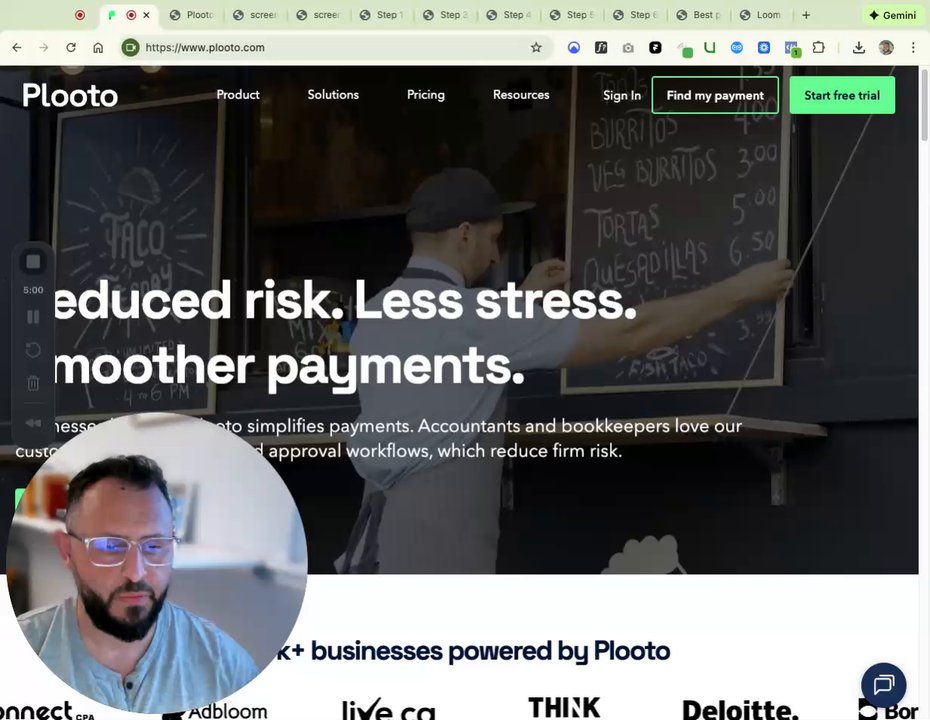
In this edition of Growth Teardowns, we’re looking at Plooto: a solid B2B payment platform that is currently suffering from a self-inflicted activation wound.
The High Stakes of the "Trust Tax"
Plooto is in the business of trust. They handle accounts payable and receivable for businesses. Naturally, they need to verify who you are. But there is a fundamental tension in product design: The Effort vs. Value Balance.
Every time you ask a user for a piece of data, a bank connection, or an ID upload, you are charging them "Effort." If you haven't delivered enough "Value" to offset that cost, the user leaves.
Plooto is currently charging a massive upfront "Trust Tax" before the user has even seen the dashboard. They are asking for a blood oath before they’ve even shown the user the value of the software.
The 10-Step Activation Gauntlet
When a user signs up for Plooto, they aren’t just creating an account. They are entering a high-friction gauntlet. Here is the breakdown of what a user has to do before they can even explore the product:
Email/Password Creation: Standard.
Email Verification: The first point of friction. The user has to leave the app, find the email, and click back.
Business Details: Name, address, industry.
Role Selection: Identifying who they are.
Connecting a Bank Account: This is the big one. They ask for a Plaid or manual connection immediately.
Identity Verification: Uploading documents or providing personal details.
Adding a Payee: Asking the user to start working before they know how the tool works.
Setting Up Approval Workflows: Deep configuration.
Funding the Account: Asking for capital commitment.
Final Review: Waiting for Plooto to "approve" the account.
By the time the user hits step 5, the "drop-off" cliff is vertical.
Why Conventional Onboarding Fails
Most product teams justify this gauntlet with a single word: Compliance.
They argue that because they are a FinTech company, they must have this information to satisfy KYC (Know Your Customer) and AML (Anti-Money Laundering) regulations. This is a common fallacy that results in expensive mistakes.
While compliance is non-negotiable, the timing of compliance is a choice.
Conventional onboarding assumes that if a user is "serious," they will jump through the hoops. But in a B2B SaaS environment, your primary competition isn't another software: it's inertia. Your user is likely trying five different tools simultaneously. If Tool A shows them a dashboard and a "dummy data" version of their future life in 30 seconds, and Tool B (Plooto) asks for their corporate bank login and tax ID before showing them a single pixel of the UI, Tool A wins every time.
Plooto is stacking friction. They aren't just asking for one hard thing; they are asking for ten hard things in a row. This creates "Activation Drag."
The Traction-Based Validation Lens
At VentureLabbs, we look at this through the lens of Buyer Signals. If a user gives you their email, that is a weak signal. If they connect a bank account, that is a strong signal.
The mistake is demanding the strongest signal (Bank Access) at the weakest point of the relationship (Initial Sign-up).
A more effective "Growth Teardown" approach would be to reverse the flow using Progressive Disclosure:
The "Teaser" Dashboard: Let the user into the app immediately after email verification. Use "dummy data" to show them exactly what their AP/AR workflow will look like.
Micro-Aha Moments: Let them upload an invoice. Let the AI scan it and show how it would be paid. No bank connection required yet.
The Triggered Request: Only when the user clicks "Send Payment" do you ask for the bank connection. At that point, the user has a specific goal. They have "Skin in the game." The effort of connecting the bank is now justified by the immediate value of sending that specific payment.
By asking for everything upfront, Plooto is treating every sign-up like a high-intent lead. In reality, most sign-ups are "window shoppers." You don't ask a window shopper for their credit card before they walk into the store. You let them browse, touch the fabric, and see the price tag.
The Capital Risk of Friction Stacking
For a VP of Product or a PE operator, this isn't just a "UX problem." It’s a capital allocation problem.
If your activation rate is 10%, you have to spend 10x more on marketing to get one active user. If you can move that activation rate to 30% by delaying the "Trust Tax" until the user sees value, you have effectively tripled your marketing budget without spending another dime.
Plooto’s current flow assumes that the user’s motivation is at its peak during sign-up. In reality, motivation is often at its peak right after the first small win.
When we audit GTM strategies, we look for these "leaks." Often, companies try to solve a growth problem by buying more traffic (Top of Funnel), when the real problem is a "leaky bucket" at the activation stage.
The Operator's Takeaway
If you are evaluating your own product's onboarding, ask these three questions:
Are we charging a "Trust Tax" too early? (Asking for sensitive data before delivering value).
Can we use dummy data to show, not tell? (Letting the user see the "promised land" before they have to work for it).
Is our friction "stacked" or "staged"? (Spread the hard tasks throughout the first week of usage, rather than the first five minutes).
Plooto has a great product, but their front door is locked with five different padlocks. For the busy CFO or office manager, that’s five reasons to go back to using Excel or a competitor with a lower barrier to entry.
Want your product considered for a future Growth Teardown?
We’re looking for B2B platforms, FinTech tools, and complex SaaS products that want a fresh set of eyes on their activation and GTM strategy.
If you’re evaluating a new initiative and want traction evidence before committing more budget to a leaky funnel, let’s talk.