GTM Experiments Vs. Strategy Decks: Which Actually Drives PE Value Creation?
GTM Experiments Vs. Strategy Decks: Which Actually Drives PE Value Creation?
Hussein Saab
Jan 19, 2026
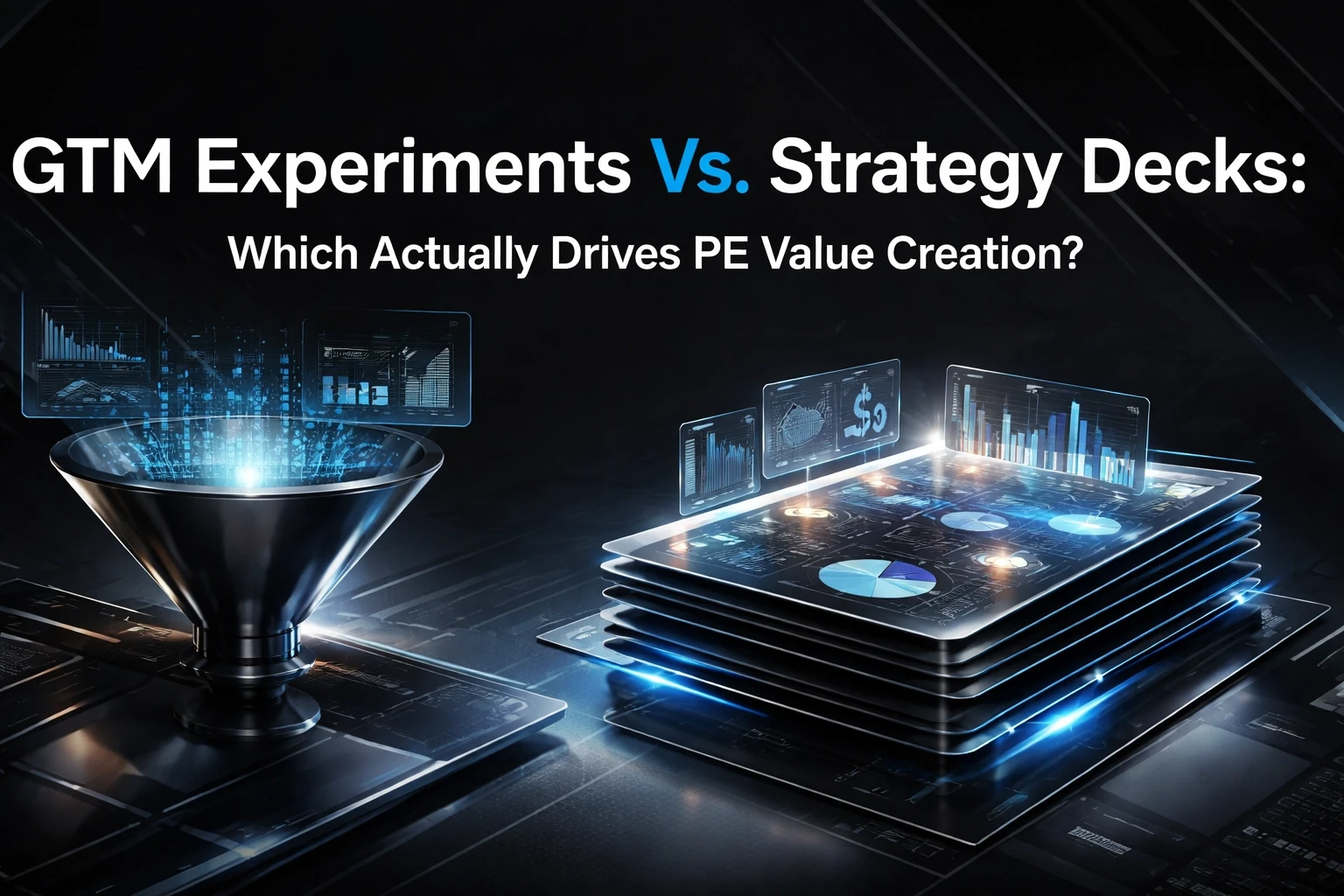
GTM Experiments Vs. Strategy Decks: Which Actually Drives PE Value Creation?
You've seen this play out. A PE firm acquires a portfolio company. The first ninety days are consumed by consultants building strategy decks. Slides get refined. Stakeholders debate positioning. Market sizing exercises drag on.
Six months later, the deck is "complete." But revenue hasn't moved. Pipeline looks the same. The board is asking hard questions.
Meanwhile, the market kept moving. Competitors kept testing. Buyers kept evolving.
This is the hidden cost of strategy-deck culture in PE-backed companies. And it's killing value creation timelines.
The Strategy Deck Problem Nobody Talks About
Here's what traditional strategy decks actually are: static documents that are slow to create and even slower to change, often becoming irrelevant months before the next planning cycle.[1]
That's not an opinion. That's the reality of how strategy decks function in fast-moving markets.
PE operating partners and portfolio CEOs know this intuitively. They've watched decks get built, presented, approved: and then ignored. Not because the thinking was bad. Because by the time the deck was "done," the assumptions underneath it were already stale.
Strategy decks optimize for internal alignment. They make boards comfortable. They give everyone something to point to.
But they don't generate revenue. They don't validate assumptions. They don't tell you whether buyers actually want what you're planning to sell.
Why PE Value Creation Stalls
The typical PE value creation playbook looks something like this:
Months 1-3: Strategic assessment. Consultant-led market analysis. Competitive positioning exercises. Slide decks multiply.
Months 4-6: Go-to-market "strategy" finalized. Hiring plans built around untested assumptions. Marketing budgets allocated to channels that haven't been validated.
Months 7-12: Execution begins. Results underwhelm. The strategy gets blamed. Another round of decks gets commissioned.
Sound familiar?
The problem isn't the people. The problem is the sequence.
You can't create value by planning in isolation from the market. You create value by getting market signals and acting on them. Fast.
A strong GTM strategy doesn't happen in a kickoff meeting. It's built by validating assumptions, aligning your system to buyer behavior, and tightening execution over time.[2]
What GTM Experiments Actually Do
GTM experiments flip the script. Instead of spending months building a strategy, you spend weeks testing it.
The mechanics are simple: define a hypothesis, primary metric, and decision rule before testing.[3]
For example, instead of projecting customer acquisition cost in a deck, you test and say: "We acquire customers at $390 right now, but we think we can optimize that to $240 per customer": backed by evidence.[4]
That's not a guess. That's a data point you can make decisions on.
This creates a dynamic strategy that allows you to make smart, data-backed pivots in weeks, not years.[5]
The PE Value Creation Difference
Here's why this matters for PE-backed companies specifically:
Hold periods are getting shorter. You don't have three years to figure out if your GTM motion works. You need signal in the first 90-180 days.
Capital allocation decisions need evidence. Should you hire five more SDRs? Build out a partner channel? Expand into enterprise? Strategy decks give you projections. GTM experiments give you proof.
Board credibility requires results. Operating partners can present strategy all day. What moves the conversation is showing traction: or showing you've killed a bad assumption before it burned capital.
The companies that create real value aren't the ones with the best decks. They're the ones that learn fastest.
What Actually Works
The winning approach isn't "decks vs. experiments." It's leading with experiments and letting strategy emerge from evidence.
Start with a limited-scope segment: by persona, region, or use case: and run a pilot motion with tight control over variables.[6] Instrument the full funnel to spot what's actually driving conversion. Review data weekly with GTM leaders. Refine based on findings.
This isn't about abandoning strategic thinking. It's about grounding strategy in reality instead of assumptions.
Here's what that looks like in practice:
Week 1-2: Identify the highest-leverage GTM assumption. Maybe it's pricing. Maybe it's ICP. Maybe it's channel. Pick one.
Week 2-3: Design a fast test. Real prospects, real messaging, real offers. Not surveys. Not focus groups. Actual market exposure.
Week 3-4: Collect data. Measure conversion, engagement, objections. Document what you learn.
Week 4+: Make decisions based on evidence. Scale what works. Kill what doesn't. Move to the next assumption.
In 30 days, you've learned more about your market than six months of strategy work would have produced. And you've done it with real buyer signals, not internal opinions.
The Deck-First Trap
Why do smart operators still default to strategy decks?
A few reasons:
Comfort. Decks feel like progress. They're tangible. You can point to them. Experiments feel uncertain until the data comes in.
Politics. Decks create buy-in. Everyone gets to weigh in. Experiments require someone to own a hypothesis: and potentially be wrong.
Legacy process. Most PE operating playbooks were built in slower markets. The "strategy first, execution second" sequence made sense when markets moved slower. It doesn't anymore.
But here's the hard truth: decks don't de-risk capital decisions. Evidence does.
If you're deploying capital based on slide assumptions, you're gambling. If you're deploying capital based on validated market signals, you're investing.
PE firms that figure this out: that build experiment-led operating models: will outperform those still stuck in deck cycles.
When Strategy Decks Make Sense
To be clear: strategy decks aren't useless. They have a role.
Decks work for communicating decisions that have already been validated. They work for board presentations when you need to summarize what you've learned. They work for aligning large teams around a direction that's been proven.
What they don't work for: figuring out what to do in the first place.
Use experiments to discover. Use decks to communicate. Get the sequence right.
The Real Question for PE Leaders
If you're an operating partner or portfolio CEO, ask yourself:
How much of your GTM strategy is based on tested assumptions vs. internal consensus?
If the answer is "mostly consensus," you're carrying more risk than you think. Every untested assumption is a potential capital trap.
The fix isn't more analysis. It's faster learning.
Moving From Decks to Evidence
The shift doesn't require blowing up your entire operating model. Start small:
Pick one portfolio company. Identify their biggest GTM assumption. Run a 30-day experiment to test it. See what you learn.
If the experiment validates the assumption, you've de-risked a major decision. If it invalidates it, you've saved months of wasted execution and potentially millions in misallocated capital.
Either outcome is a win. That's the point.
Ready to replace internal debate with real market evidence? At VentureLabbs, we run 30-day Revenue Experiment Sprints designed specifically for PE-backed companies and growth-stage SaaS teams stuck in strategy cycles. If your GTM assumptions need market proof before you commit capital or headcount, let's talk.
Sources
[1] GTM strategy documentation research, 2024-2025.
[2] Go-to-market validation methodology, industry best practices.
[3] Experimentation framework standards, GTM testing literature.
[4] Customer acquisition cost testing methodology, SaaS benchmarks.
[5] Dynamic strategy development research, 2024-2025.
[6] Pilot motion design principles, GTM experimentation guidelines.