
The Clay Paradox: Why Every GTM Team Buys the Hype but Fails the Execution
The Clay Paradox: Why Every GTM Team Buys the Hype but Fails the Execution
Hussein Saab
Apr 1, 2026
GTM
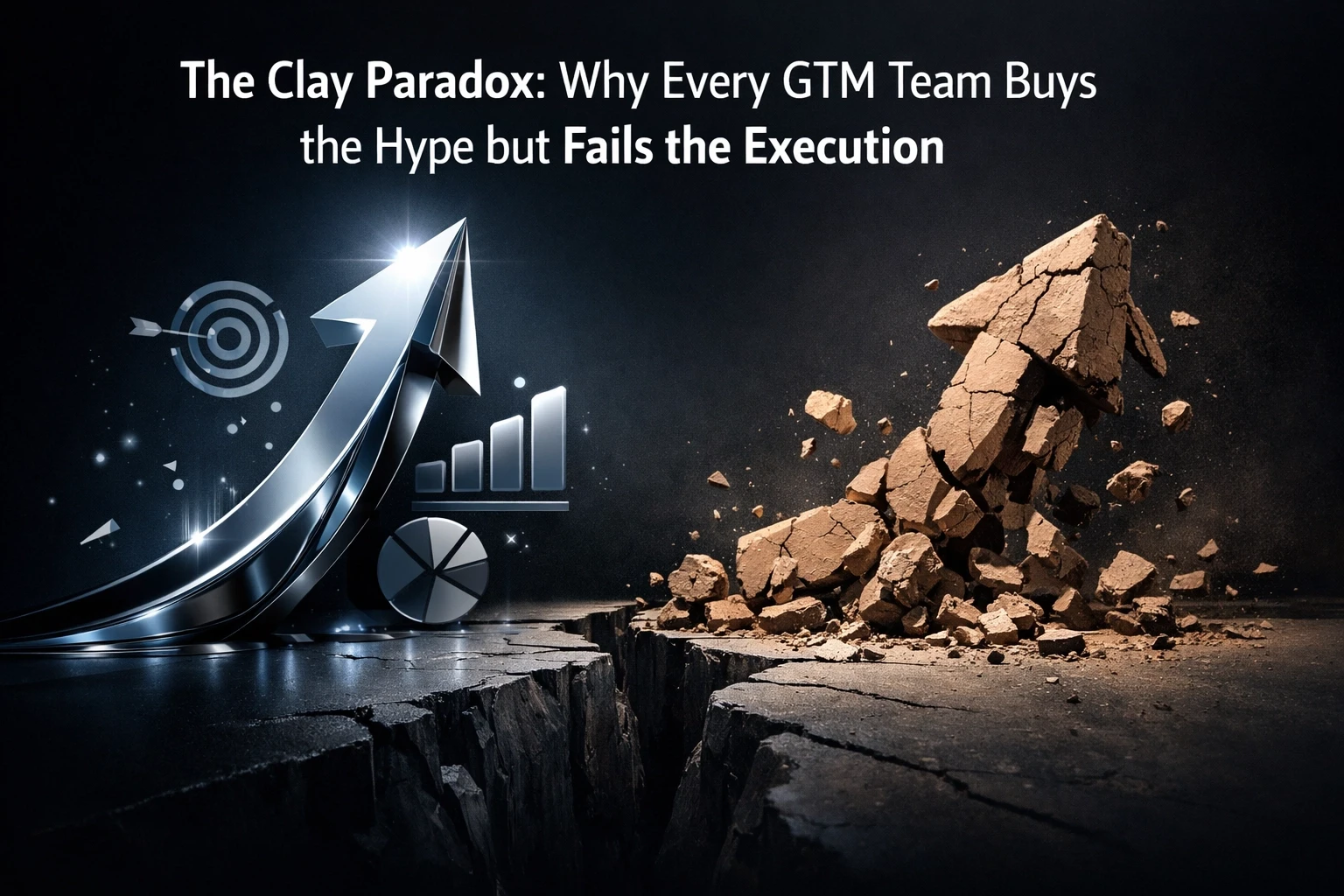
The Clay Paradox: Why Every GTM Team Buys the Hype but Fails the Execution
I see the same line item appearing on almost every B2B SaaS cap table and expense report lately: Clay.
It’s the current "it" tool. It’s the Product Hunt darling that swept the Golden Kitty awards and convinced every Head of Sales that they’re just one "automated enrichment workflow" away from a $100M pipeline. It’s valued at hundreds of millions, it’s sleek, and the UI looks like a friendly spreadsheet.
But here’s the reality I’m seeing on the ground: Most GTM teams are paying $3,000 a month for a glorified Excel sheet they don’t know how to turn into revenue.
They’ve bought the "magic," but they lack the engineering-level execution required to make the wand wave. This is the Clay Paradox: The more powerful a tool makes your outbound look in a demo, the more likely it is to become a massive cost creeper and a revenue discovery dead end in the hands of a beginner.
The $400,000 Reality Check
A few weeks ago, I met a guy who is making $400,000 a year doing one thing: implementing Clay for mid-market companies.
Think about that for a second. Companies are so desperate to make this "simple" tool work that they are paying a single consultant nearly half a million dollars just to set up the plumbing. Why? Because Clay isn't a tool; it's a data engine. And most GTM teams aren't engineers: they’re just people trying to hit a quarterly quota with a map they can’t read.
If you’re a VP of Product or a Founder, and you think you can just hand a Clay login to a 23-year-old SDR and expect a scalable outbound machine to pop out the other side, you aren't just optimistic: you’re being reckless with your capital.
You’re committing budget to a tool before you’ve proven you have the technical chops or the strategic clarity to handle it. At VentureLabbs, we talk a lot about traction before capital commitment. Clay is the ultimate test of that principle.
Why Conventional GTM Logic Fails the "Clay Test"
Most GTM strategies are built on "slide-deck logic." You identify a segment, you buy a list from ZoomInfo, you throw it into a sequence, and you pray for a 1% meeting rate.
When that fails, the typical response is to buy more tech. "We need better data," the VP says. So, they buy Clay.
But Clay doesn't give you better data; it gives you access to 50+ data providers and the ability to write complex logic to filter them. If your underlying strategy is "spam more people with slightly more personalized variables," you’re just accelerating your path to a burned domain and a blacklisted workspace.
The failure isn't in the tool. Clay is incredible: if you know how to use it. The failure is in the activation gap. It’s the same thing I wrote about in our teardown of Airtable’s 'blank canvas' trap. When you give a team infinite power without a structured framework, they don't innovate; they paralyze.
The "Data Buffet" Indigestion
The trap of the "Product Hunt popular" tool is that it makes sophisticated work look easy. Clay’s interface is a grid. We all know how to use a grid, right?
Wrong.
Inside that grid are API calls, waterfall enrichment logic, and LLM-driven messaging prompts. To make Clay work, you need to think like a product engineer, not a salesperson. You need to understand:
Data Cascades: If Provider A doesn't have the email, check Provider B, but only if the LinkedIn profile was updated in the last 6 months.
Signal vs. Noise: Just because you can scrape a prospect’s latest 10-K filing doesn't mean you should use it to write a creepy 4-paragraph cold email.
Cost Scoping: Every "find" and "enrich" action costs credits. Without a "go/no-go" logic gate, your SDR can burn $500 of API credits in twenty minutes on a list of leads that aren't even in your ICP.
This is where the "cost creeper" effect happens. I’ve seen teams spend $5k in a month on data enrichment for a "test" that had zero kill metrics. They didn't have a plan; they just had a new toy. It’s the same trap companies fall into with HubSpot’s all-in-one ecosystem. You pay for the potential, but you live in the friction.
The Execution Blind Spot: Who’s at the Wheel?
When I talk to CEOs about their GTM stack, I ask one question: "Who owns the logic?"
Usually, the answer is "Marketing" or "Sales Ops." But Sales Ops is busy fixing CRM fields, and Marketing is busy making PDFs. Nobody actually owns the engineering of the funnel.
If you have a tool as powerful as Clay, you need a "GTM Engineer." If you don't have one, you’re just paying for a Ferrari to drive it to the grocery store at 20 mph. Worse, you’re probably hitting every curb on the way.
This is why that consultant is making $400k. He’s filling the gap between the hype of the tool and the reality of the execution. Most companies are too blind to see that their "growth problem" isn't a lack of tools: it’s a lack of technical execution within their revenue teams.
Moving from Hype to Traction
At VentureLabbs, we don't believe in "plug and play." We believe in evidence-based growth. Before you commit to a "Pro" plan on Clay or hire a specialist, you need to validate the signal.
Can you manually prove that the data signals you’re chasing actually lead to conversions? If you can’t get a meeting by manually looking up a prospect’s recent job change on LinkedIn, then automating that lookup for 10,000 people via Clay isn't going to save you. It’s just going to make your failure more expensive.
The Clay Paradox is a warning for every leader: Popularity on Product Hunt is not a proxy for ease of implementation.
Don’t buy the magic. Build the logic first. Define your kill metrics. Ensure your team has the engineering mindset to handle a data engine. If you don't, you’re just another company subsidizing the hype while your revenue stays stagnant.
Stop chasing the "it" tool and start looking for the "it" signal. If you’re tired of expensive tools sitting idle and want to see real traction evidence before you commit more budget to your GTM stack, let’s talk.
If you’re evaluating a new initiative or a high-stakes GTM tool and want traction evidence before committing your annual budget, book a discovery call with me here.