The High Cost of Consensus: Why Board Approvals are Killing Your Growth
The High Cost of Consensus: Why Board Approvals are Killing Your Growth
Hussein Saab
Feb 16, 2026
Saas Growth
The High Cost of Consensus: Why Board Approvals are Killing Your Growth
Let's presume you just walked out of a quarterly board meeting with approval for a $1.5M market expansion. The slides were clean. The benchmarking data was solid. The competitive analysis showed white space. Every executive nodded. Your CFO signed off on the budget allocation.
Your internal credibility is now tied to the success of this initiative. If it delivers, you're a strategic visionary. If it doesn't, you're the person who burned through budget on a failed bet.
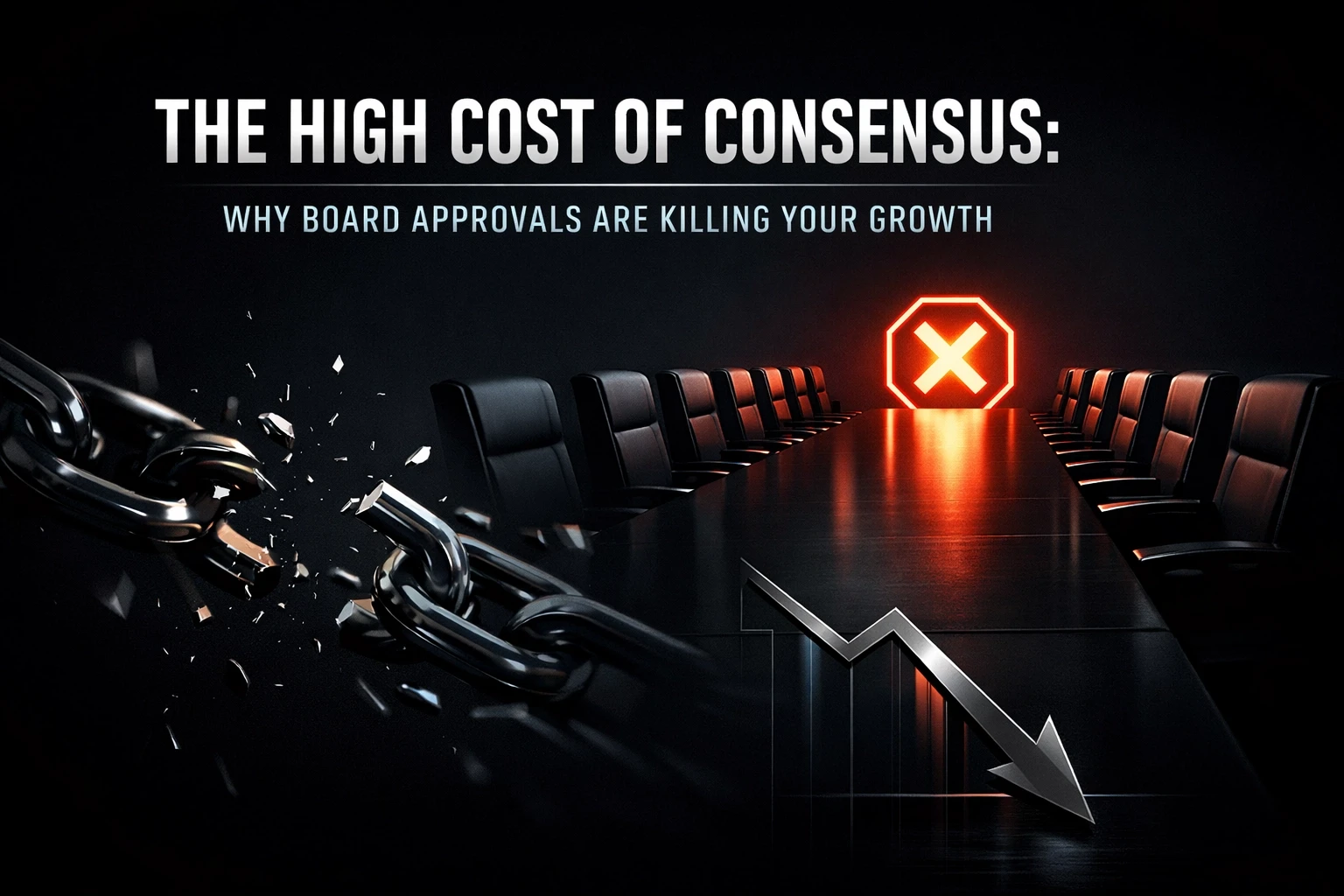
Here's the problem: board approval doesn't validate market demand. It validates internal agreement.
And internal agreement, no matter how well-researched or data-backed, has never been a reliable predictor of revenue.
Why Consensus Feels Like Validation
Boardroom consensus creates a powerful psychological effect. When smart people agree with you, it feels like proof. When your expansion deck passes executive scrutiny, it feels like the strategy has been validated.
But what actually happened in that meeting?
You presented a market sizing analysis based on TAM projections. You showed competitor pricing models. You mapped out a three-phase rollout plan with quarterly milestones. You framed the opportunity cost of not moving forward.
The board asked clarifying questions. They challenged a few assumptions. They debated timelines and resource allocation. Then they approved the budget.
None of this tested whether buyers in the target segment will actually pay for what you're building. None of this measured real buying intent. None of this established whether your pricing model will work in practice.
What you received was institutional confidence. What you didn't receive was market proof.
The Three Failure Modes of Consensus-Driven Decisions
Internal alignment fails in predictable ways. Understanding these failure modes helps explain why so many board-approved initiatives underperform.
Failure Mode 1: Slide Deck Logic Replaces Market Signal
Most expansion strategies are built on analyst reports, market sizing exercises, and competitive benchmarking. These inputs create the appearance of rigor. They allow teams to model revenue potential and build financial projections.
But they don't answer the only question that matters: will buyers commit budget to this offering at the price point you're modeling?
Slide decks optimize for boardroom credibility, not market reality. They're designed to secure approval, not to test demand. The frameworks that convince executives are not the same frameworks that generate revenue.
Failure Mode 2: Institutional Momentum Overrides Kill Signals
Once a board approves an initiative, stopping it becomes politically difficult. The decision carries the weight of executive consensus. Reversing course looks like poor planning or wasted diligence.
This creates a dynamic where early negative signals are rationalized rather than acted upon. Low pilot conversion rates get attributed to messaging problems. Pricing resistance gets framed as a sales enablement issue. Churn gets blamed on onboarding friction.
The initiative continues because killing it would require admitting the original approval was premature. By the time the failure is undeniable, you've burned through most of the allocated budget.
Failure Mode 3: Committees Optimize for Consensus, Not Truth
Board decisions involve multiple stakeholders with competing priorities. CFOs focus on capital efficiency. Product leaders focus on roadmap alignment. Sales leaders focus on pipeline impact. Strategy teams focus on competitive positioning.
The result is a negotiated consensus that satisfies internal politics but lacks clear market accountability. The expansion gets approved with hedged language, adjusted timelines, and softened success metrics.
No single person owns the go-or-no-go decision based on measurable market proof. Instead, the initiative moves forward because enough people agreed it was worth trying.
What Traction-Based Validation Actually Looks Like
The alternative to consensus-driven decision-making is traction-based validation. This approach prioritizes measurable buyer signals over internal agreement.
Traction-based validation doesn't replace diligence. It supplements it with real-world market proof before capital is fully committed.
Structured 30-Day GTM Experiments
Instead of approving a full-scale expansion, run a constrained market test. Define a narrow segment. Build a minimal offer. Set a clear pricing model. Run targeted outreach for 30 days.
The goal isn't to generate revenue at scale. The goal is to measure whether buyers demonstrate real interest at your proposed price point.
If you're targeting mid-market healthcare companies with a new module priced at $15K annually, can you get five qualified prospects to agree to a pilot in 30 days? If you can't generate that level of interest with focused effort, scaling to a full sales motion won't fix the problem.
This approach exposes demand gaps early, when pivoting is cheap. It replaces theoretical TAM models with actual buyer behavior.
Pre-Commit Demand Over Stated Interest
Surveys and interviews generate opinions. Pilots with budget commitment generate proof.
Most market validation efforts rely on customer development interviews. Prospects say the problem is important. They confirm the pain point exists. They express interest in a solution.
Then the product launches and conversion rates fall short of projections.
The gap between stated interest and actual purchasing behavior is where most expansions fail. Traction-based validation closes that gap by requiring prospects to demonstrate commitment before you build.
This might mean signed LOIs for a pilot. It might mean deposits or pre-orders. It might mean agreement to a 90-day paid proof-of-concept.
The specific mechanism matters less than the principle: real buyers put something at risk when they're serious.
Kill Metrics Defined Before Engineering Begins
Every expansion initiative should have clearly defined kill metrics before resources are deployed.
If pilot conversion is below 15%, we stop. If average deal size is below $10K, we reassess. If sales cycle exceeds 120 days, we re-scope.
These thresholds should be agreed upon when the initiative is approved: not negotiated after poor results emerge.
Kill metrics protect your internal credibility. They demonstrate that you're operating with discipline, not hope. They allow you to pull the plug without it reflecting poorly on your judgment, because the decision framework was established upfront.
Most importantly, they prevent the institutional momentum problem. When kill criteria are predefined, stopping an underperforming initiative becomes a sign of good governance, not failure.
The Political Reality of Evidence-Based Decisions
Introducing traction-based validation into a consensus-driven organization requires navigating internal dynamics carefully.
Boards and executives are accustomed to approving initiatives based on strategic rationale. Asking for a validation phase before full commitment can feel like a delay tactic or a lack of conviction.
The framing matters. Position the validation sprint as de-risking the larger allocation. Emphasize that you're protecting the board's confidence in the initiative by generating proof before scaling.
Present kill metrics as decision discipline, not pessimism. Frame pre-commit demand as a calibration exercise that improves pricing strategy and go-to-market sequencing.
The goal is to shift the internal narrative from "should we do this?" to "what evidence do we need to commit confidently?"
This reframing reduces the political cost of negative results. If a pilot underperforms, it's not a strategic failure: it's a successful validation exercise that prevented a larger capital mistake.
When Consensus Is Necessary But Not Sufficient
Board approval will always be required for meaningful capital allocation. The argument here isn't that consensus is irrelevant.
The argument is that consensus alone is insufficient.
Internal agreement should authorize a validation phase, not a full build. It should greenlight a structured experiment, not an irreversible commitment.
The best operators treat board approval as permission to generate proof, not as proof itself.
If you're evaluating a new market expansion, pricing shift, or product build: and you want measurable traction evidence before committing full budget: let's talk. Book a discovery call at https://cal.com/strategyxweb/venture-labbs-intro.