
Growth Teardown: What $488 Million Couldn't Fix at Outreach.io
Outreach raised $488M, hit $300M ARR, and still laid off staff 5 times. Here's the SaaS growth strategy mistake that let Apollo eat their lunch.
Hussein Saab
May 13, 2026
GTM, Pricing, Raising
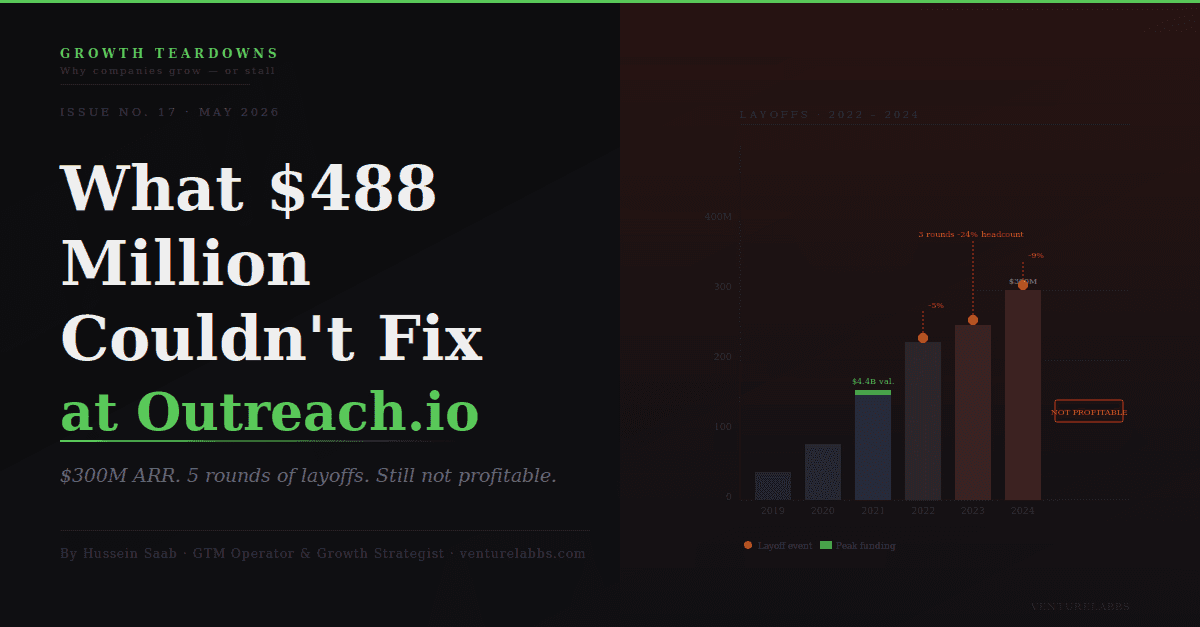
Five rounds of layoffs in two years.
When that happens, it's not a market correction or other bs reason. It's more commonly a structural problem that no amount of repositioning or rebranding fixes. Outreach.io laid off employees in August 2022, February 2023, August 2023, September 2023, and November 2024. Each time, the press release said something about "aligning with strategic growth plans" and "path to profitability." Many companies leading with vanity metrics end up on this same path, below is my breakdown.
They have $488 million in funding and $300 million in annual revenue. They still aren't profitable.
Meanwhile, Apollo.io, a competitor that raised a fraction of what Outreach did grew 40% year over year in 2024 and is accelerating. Apollo charges $49 a month. Outreach charges $120 per seat, hides the full pricing behind a sales call, and requires a dedicated sales ops person to keep the platform running.
I'm not here to write an obituary for Outreach. The product genuinely works for enterprise sales teams that need deep workflow automation and Salesforce integration. But there's a very specific GTM trap playing out here that I see growth-stage companies walk into constantly and it's worth understanding before you build your pricing model, your sales motion, or your product roadmap around the same assumptions Outreach did.
What They Built Was Real
Outreach earned its position. Founded in 2014, they identified a genuine problem: sales reps spending more time on administrative tasks than actually selling. They built a platform that automated sequences, tracked engagement, logged everything to Salesforce, and gave managers visibility into pipeline they'd never had before.
The growth followed. From $1M ARR in 2016 to $40M by 2019 to over $200M by 2022. A $4.4 billion valuation. Customers like Zoom, Siemens, DocuSign, and Okta. A seat at the table in every enterprise sales tech evaluation. By 2021, Outreach wasn't just a product it was a category standard. If you ran a serious outbound sales team, you either had Outreach or you explained why you didn't.
That's a real GTM motion executed well for a sustained period.
So why five rounds of layoffs?
Three Places the Wheels Came Off
The Complexity Premium Expired
Outreach built a powerful, deeply configurable platform. In 2019, that was a competitive advantage. Enterprise buyers wanted sophistication. They had large ops teams, dedicated admins, and the budget to pay for platforms that required setup and maintenance.
That market moment expired.
Post-2022, companies started cutting sales teams, tightening software budgets, and asking harder questions about ROI on every tool in the stack. The same complexity that made Outreach impressive in a growth environment became a liability in a lean one. Reviewers on G2 started flagging it consistently: the UI feels bloated, new reps get overwhelmed, and you need a dedicated ops person just to keep the system aligned. This is a product-market fit problem at a specific buyer moment, or problem-solution-fit prob to be precise.
The buyers who could absorb that complexity were the same buyers cutting headcount. The buyers who couldn't afford that complexity were the ones still hiring and they were choosing Apollo.
The Pricing Wall
Outreach's pricing is quote-based. You can't find a number on their website. You request a demo, go through a discovery process, and get a custom proposal. For enterprise deals with six-figure ACVs and procurement teams, that's fine. For a growth-stage company trying to decide between three tools in a weekend, it's a dealbreaker.
Apollo starts at $49 a month with a free plan. You can be running sequences by Tuesday afternoon. No sales call. No implementation fee. No three-week onboarding project.
Outreach's core differentiators are increasingly becoming table stakes what the market calls the "Gongification" effect. As HubSpot, Apollo, and ZoomInfo all built comparable engagement features into their platforms, the gap between "Outreach-level" and "good enough" narrowed significantly. When your differentiation compresses and your price stays high, the math stops working for anyone except your most locked-in enterprise customers.
The pricing wall didn't just slow down new customer acquisition. It actively handed Apollo the mid-market. Every growth-stage company that evaluated both and picked Apollo based on price and simplicity is a customer Outreach will never get back, because once a team builds their workflow around a tool, switching costs are real.
The Profitability Paradox
Here's the number that tells the whole story: $488 million raised, $300 million in annual revenue, not profitable.
For context, Apollo hit $134M ARR in 2024 growing at 40% and is on a clear path to profitability. Outreach hit $300M ARR growing at roughly 11% and keeps cutting headcount to chase a profitability target they haven't reached yet.
That gap isn't about product quality. It's about cost structure and go-to-market efficiency. Outreach built a high-touch, enterprise-oriented sales motion field reps, account executives, implementation teams, customer success managers at a time when that model commanded premium pricing and had clear ROI. As pricing pressure from cheaper alternatives increased, that cost structure became harder to justify. You can't maintain an enterprise sales cost structure on a customer base that's partially defecting to a self-serve competitor.
Outreach cut 9% of its workforce in November 2024, the fifth round of cuts in roughly two years. Each cut was framed as an efficiency move. But five efficiency moves in two years isn't operational discipline it's a business model under pressure that hasn't found its new equilibrium.
The Pattern: The Enterprise Complexity Trap
What's happening to Outreach has a name. I call it the Enterprise Complexity Trap.
It works like this: you build a sophisticated product for a sophisticated buyer at a specific market moment. You win on depth, configurability, and integration capability. You raise money, build a high-touch sales motion, and price at a premium. The model works until the market shifts.
When budgets tighten and buyers get leaner, the complexity that was your moat becomes your friction. A cheaper, simpler competitor enters from below not building a better product, but building a good-enough product with a better go-to-market: transparent pricing, self-serve onboarding, faster time to value. Your existing customers stay because switching is painful. But new customer acquisition slows. Growth rate compresses. Your cost structure, built for a faster-growing revenue base, starts showing cracks.
This is not a story unique to Outreach. I see versions of it in growth-stage companies every month. The details change. The pattern doesn't.
Three Questions to Run on Your Own Business Right Now
What happens when a prospect tries to understand your pricing without talking to sales? If the answer is "they can't," you've built a friction wall that filters out every buyer who isn't already highly motivated. That's fine for pure enterprise plays with long sales cycles. It's fatal for any motion that depends on velocity, trial, or self-serve adoption. Know which game you're playing because both have different cost structures.
Is your product's complexity a feature or a liability for your current buyer? The answer changes depending on whether your buyer has a team to manage it. Outreach's depth is genuinely valuable to a VP of Sales with a RevOps team. It's overwhelming to a founder-led sales team of three. If your ICP is shifting toward leaner organizations, ask honestly whether your product's configurability is still a competitive advantage or whether it's now a reason someone chooses the simpler alternative.
What's your growth rate relative to your cost structure? Revenue is a vanity metric if your cost of generating it is accelerating faster. Outreach at $300M ARR with five rounds of layoffs tells a story about unit economics that the top-line number doesn't. If your growth rate is compressing while your burn stays flat or increases, the problem isn't sales it's structural. Fix the structure before you hire the next VP of Sales to solve it.
If you ran those three questions and something felt uncomfortable, that discomfort is data. Run the full diagnostic at growthleakfinder.com — it takes five minutes and shows you exactly where the leak is before it becomes five rounds of layoffs.
If you want to go through it live, grab 30 minutes here.
And if you want me to run this teardown on your company — reply with your URL. I do these free.
Related: Growth Teardown: Chili Piper's Pricing Trap · Growth Teardown: HubSpot's All-in-One Trap